House approves major property tax bill |
|
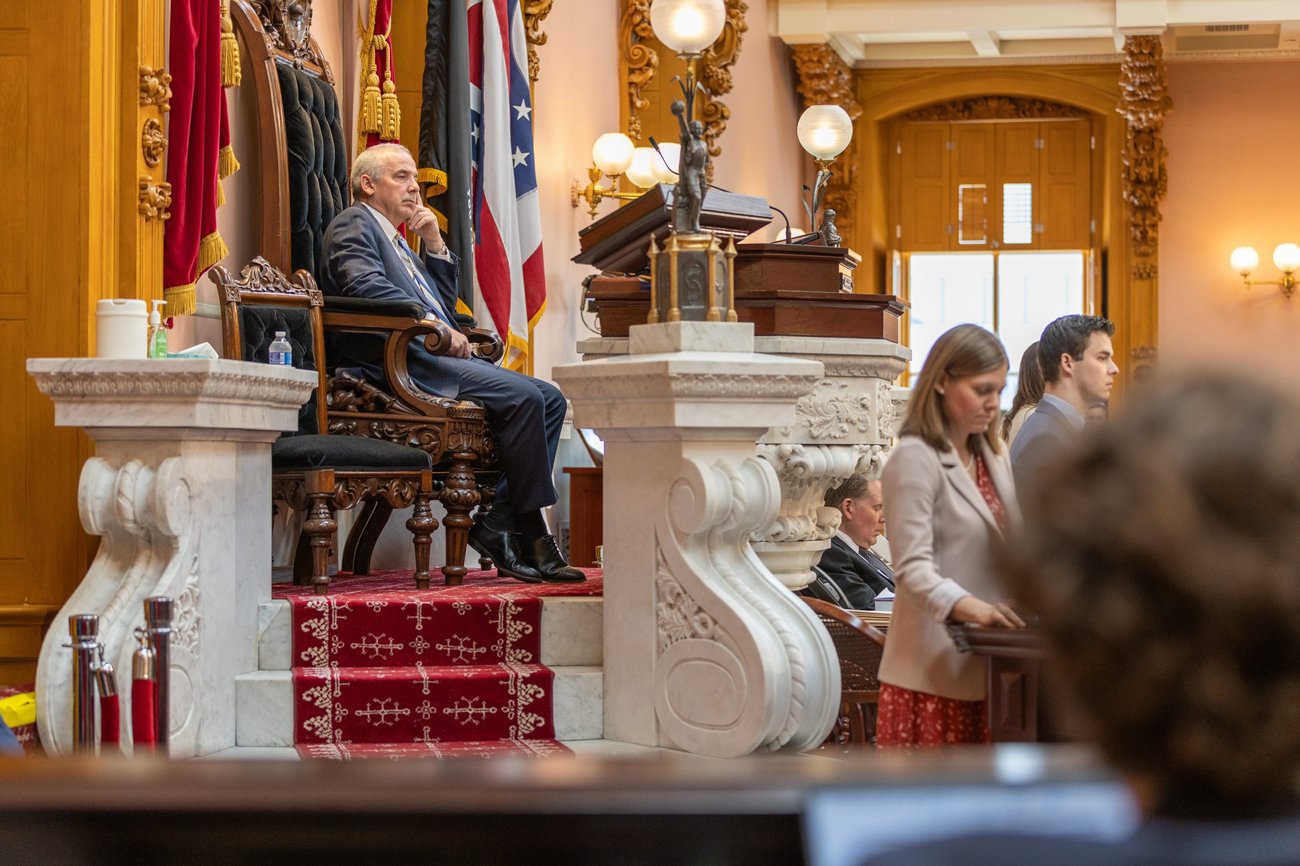
Speaker Matt Huffman and other Ohio House Republicans spiked the football Wednesday after the chamber approved a pair of bills that cut future property taxes by $2 billion over the next three years. During a post-session press conference, he displayed a graphic in the back of the room reading “Stop the Spikes.”
Andrew wrote about the details of the property tax bills, which still need approval from the state Senate and Gov. Mike DeWine to become law.
The new bills cap, at the rate of inflation, how much money school districts and local governments can collect in the future from tax increases resulting solely from rising property values. One of the bills, House Bill 186, also would grant future discounts to property owners who have seen their taxes go up more than that.
There’s a catch, though. The new tax cuts would only apply in school districts that have hit what’s known as the 20-mill floor — the minimum property-tax rate for schools under state law. As property values have surged recently, more districts have dropped to that floor and seen some of the steepest tax increases as a result, even without voters approving new levies. Republicans say they’re trying to address that quirk in the state’s tax formula. These districts also tend to be in less populated parts of the state.
Shortly before the bills passed, House Republicans added $300 million in one-time funds to address complaints from school leaders who say that the reduced future revenue could force them to make painful cuts.
The change helped the bills win bipartisan support – each got at least 10 “yes” votes from Democrats – with an interesting wrinkle. Nearly all of the Democrats who supported the bills represent suburban districts that should be the top House battleground races in the November 2026 election, while the “no” votes generally came from Democrats in safe districts.
This shows how lawmakers facing a tough re-election campaign may feel pressure to act on property taxes, regardless of whether the longshot citizens campaign to repeal property taxes altogether ends up making the ballot.
|
|
|
|
|
Making sense of the Statehouse |
|
What happens in Columbus doesn't stay in Columbus. At Signal Statewide, we track what lawmakers are debating – and what it means for your town, school, or small business. Our team explains complicated bills, asks tough questions and puts the focus where it belongs: on everyday Ohioans. If our reporting helps you stay informed, have better conversations, or feel more in control of what's going on in Ohio, we hope you'll support it.
|
| 🤍 JOIN THE MOVEMENT |
|
|
|
What are you smoking? |
|
The Ohio House thinks it cut the Gordian knot with new legislation that regulates marijuana without thwarting the will of Ohio voters, ends underage sales of the knockoff “intoxicating hemp,” but still allows its sale at bars in "cannabinoid drinks,” all while ensuring the local governments keep their piece of the tax money.
And they did it all, in the words of House Finance Chair Brian Stewart, while making sure Ohio doesn’t “smell like a Grateful Dead concert.” (The bill puts tighter rules on smoking pot than on smoking cigarettes).
Jake Zuckerman wrote up details on the bipartisan bill that passed the House on Wednesday.
But as House Republicans like to say (in jest?), the problem isn’t the Democrats; it’s the malcontents in the Senate. There, Senate President Rob McColley said the two chambers will need a conference committee to hash out the details.
That can end anywhere between meeting in the middle and effectively writing and quickly passing a brand new bill. Stay tuned.
|
|
|
Redistricting recap |
|
There’s still a whole lot of nothing happening publicly when it comes to redrawing Ohio’s congressional map. But top Republicans and Democrats this week shared a bit about what’s going on behind the scenes.
As Andrew wrote earlier this week, the talks between the two sides revolve around the future of Ohio’s three competitive congressional districts, according to state Rep. Stewart, a Republican who serves on the redistricting commission. The Ohio Redistricting Commission met Tuesday and did little, failing even to agree on which procedural rules to use for their meeting. National and state Democrats, meanwhile, are potentially gearing up for a signature-gathering campaign to try to repeal the map. Read more here.
A Republican map will likely come in mid-November, unless there’s an unexpected breakthrough in bipartisan negotiations this month. |
|
|
Could the Senate president jump into a congressional race? |
|
Even without any map changes, the top pickup opportunity for congressional Republicans in Ohio is the 9th Congressional District, represented by longtime Democratic Rep. Marcy Kaptur. The district is Republican-leaning even in its current form. President Donald Trump won it by nearly 7 percentage points last November.
Three Republicans have officially announced campaigns: state Rep. Josh Williams, former state representative Derek Merrin and Alea Nadeem, an Air Force veteran and first-time candidate.
A fourth Republican candidate may enter soon. Republican sources say that Senate President Rob McColley, who lives just outside the district as it’s currently drawn, is seriously considering a campaign and attracting interest from national Republicans. The possibility injects a layer of intrigue into redistricting, which McColley has a key role in through his legislative leadership position.
McColley declined to comment on his potential candidacy Wednesday, saying he doesn’t discuss political issues at the Statehouse. |
|
|
Frank LaRose takes step toward ending at least one campaign |
|
Ohio Secretary of State Frank LaRose took a major step toward retiring his federal campaign account last week, new federal campaign finance records show.
In August, LaRose paid himself $14,400 from his campaign to help pay off a loan he personally made to his failed 2024 U.S. Senate campaign. LaRose had loaned his campaign $250,000 overall, but he repaid $225,000 of it in April 2024, the month after finishing third in the Republican primary.
After the latest repayment and a couple other minor expenses, LaRose’s campaign has about $700 remaining. The campaign still owes him $10,600, which at this point he may never recoup, unless he runs for federal office again some day.
LaRose now is running for state auditor in the November 2026 election, although he’s also been auditioning to be Republican gubernatorial candidate Vivek Ramaswamy’s running mate.
|
Open the pod bay doors, Hal |
|
Committee hearings began Tuesday on House Bill 469, which would declare in law that “No AI system shall be granted the status of … any form of legal personhood, nor be considered to possess consciousness, self-awareness, or similar traits of living beings.”
It forbids AI marriages and says AI can’t own real estate.
But perhaps more importantly, the bill says “any direct or indirect harm” caused by an AI system is the legal responsibility of the developers – not the AI itself.
The legislation could have serious implications for companies behind increasingly potent and popular software like Meta AI and ChatGPT, which have both been accused of contributing to deaths and suicides of people who formed relationships of different sorts with their techno-companions.
“Humans are responsible, humans are liable before the court,” said Rep. Thad Claggett, a Republican and sole sponsor of the bill.
|
|
|
|
|
|
|
|
|
Oct. 22 | By Jake Zuckerman |
|
If passed, the bill would release nearly $50 million per year in already collected marijuana tax revenue to communities that have chosen to allow dispensaries in town. |
| READ MORE |
|
|
|
In 1981, state lawmakers reinstated the death penalty in Ohio. More than 40 years later, dozens of the politicians who voted on the now-law – both yes and no votes – say the capital punishment system in Ohio is broken and ought to be repealed. Read more from Jake Zuckerman.
Republicans are negotiating with Democrats over the future of Ohio’s three most competitive congressional districts. But lawmakers are unlikely to publicly reveal a new map this month unless a bipartisan deal takes shape, according to Rep. Brian Stewart, a Republican who is the co-leader of the Ohio Redistricting Commission. Read more of Andrew Tobias.
Some Ohio Republicans want to invest your tax dollars in crypto. Statehouse legislation would create a “strategic cryptocurrency reserve” with public funds. Many prominent Republicans are bullish on crypto, but the powerful Speaker of the Ohio House thinks it’s “risky” and a bad idea. Read more from Jake Zuckerman. |
|
|
|
|